



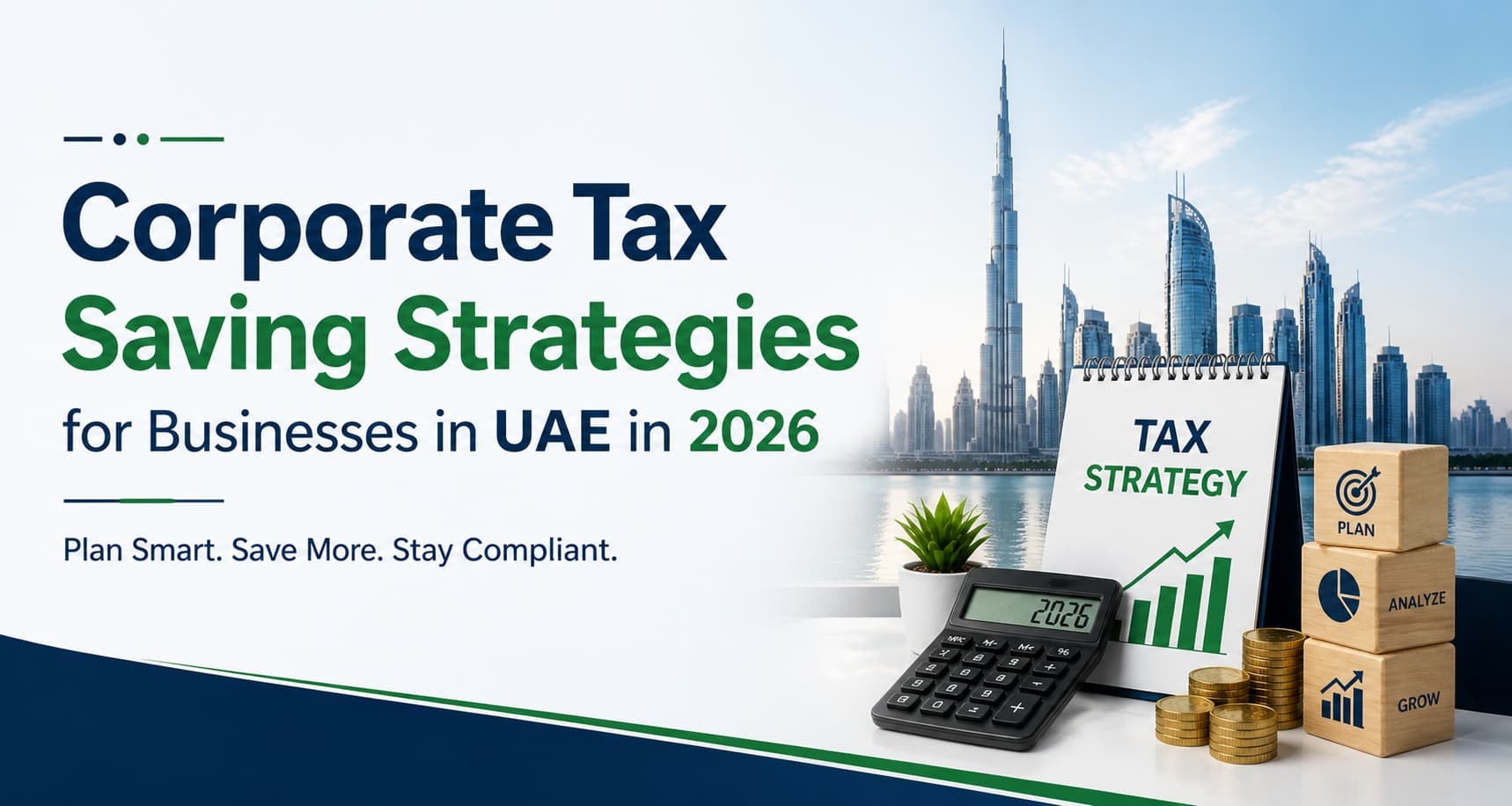
Corporate Tax Saving Strategies for Businesses in UAE in 2026
Most businesses don’t lose money because of taxes; they lose money because they don’t plan for taxes. This is my practical perspective as a tax adviser who has seen how small decisions shape big financial outcomes.
Over the years, I’ve worked with companies across different stages - startups trying to stay afloat, mid-sized firms aiming to scale, and established businesses protecting their margins. And one thing I’ve observed is that the businesses that plan early always stay ahead. With the UAE’s corporate tax system in place, my belief is that 2026 is not the year to “figure things out later” - it is the year to plan and take action.
Strategies to Implement this Year
If you’re running a business in the UAE today, you already know that UAE corporate tax is no longer new.
- 9% CT applies to taxable profits above AED 375,000, and
- 0% tax applies below that threshold
- Free zone businesses can still enjoy benefits (only if they meet the set conditions)
These sound simple, but the real skill lies in how your taxable income is calculated. Because that’s where most opportunities exist. So, here's what I recommend -
Strategy 1 - Take Advantage of Small Business Relief (If Eligible)
If your business revenue is below AED 3 million (threshold as of 2026), you may qualify for Small Business Relief In simple terms, you can elect to be treated as having no taxable income, which means no corporate tax liability. If you qualify, this is one of the cleanest ways to reduce your tax burden.
Strategy 2 - Don’t Ignore Free Zone Benefits (But Understand the Conditions)
I’ve seen businesses assume they’re eligible just because they are in a free zone. This is not true. A Qualifying Free Zone Person (QFZP) can enjoy 0% tax on qualifying income if they meet the set criteria -
- You must have adequate substance in the UAE
- Your business activity must fall under “qualifying activities.”
- You should not opt into the regular tax regime
Hence the eligible entities can benefit from the freezone benefits and hence can reduce the tax expenses under the CT
Strategy 3 - Review related party transactions before they become a problem
If your business deals with related entities, group companies, or cross-border transactions, then transfer pricing is not optional anymore. This means -
- Transactions must be at arm’s length
- Proper documentation is necessary.
Now here’s where planning helps -
- Make sure contracts clearly reflect your services, goods, or licensing arrangements
- Keep pricing consistent with how independent parties would deal
- Document the basis of pricing and any allocation method used
- Check whether costs are shared properly across entities
With these practical steps, you stay compliant, you avoid penalties, and you don’t overstate profits in high-tax exposure areas. This is not about avoiding tax; it’s about being fair and prepared.
Strategy 4 - Take Advantage of Loss Carry Forward
Not every year is profitable. And that’s okay. The UAE allows businesses to -
- Carry forward losses
- Offset them against future taxable income
Up to 75% of taxable income can be adjusted using past losses. This means if a company has AED 200,000 in carried-forward losses and makes AED 100,000 in taxable income the next year, it can only use AED 75,000 (75%) of the losses to offset that year's income. It will pay tax on the remaining AED 25,000, and the leftover AED 125,000 loss can be carried forward to the following year.
Hence, the tax can be reduced based on the provisions provided under the UAE corporate tax regime.
You can also read: Implications of VAT on Healthcare Services
Strategy 5 - Group Structuring Can Change Everything
The UAE allows for tax grouping, where multiple entities can be treated as a single taxable unit. This matters because losses from one entity can offset profits from another. So, instead of paying tax on profitable entities separately, you can balance it within the group. In my eyes, this is not just a tax move; it's a strategic move.
Strategy 6 - Stay Compliant - Because Penalties Add Up
Your business may face penalties owing to -
- Late filings
- Incorrect disclosures
- Missing documentation
- Incorrect calculation of taxes. Etc
I believe businesses that stay compliant don’t just avoid penalties - they operate with clarity.
Strategy 7 – Hire the best Tax professionals
Having the right tax experts by your side can be considered one of the best options to save and reduce tax payments. The tax experts can guide you through the tax regime and can assist in the accurate calculation of the taxable income, identifying applicable tax provisions to reduce the taxes and majorly ensuring the compliance with the tax regime. Hence, the professionals can be your tax savers.
The Way, I See It
The UAE has moved from a place of zero tax to a place that is still one of the most business-friendly tax environments in the world. To remain in an advantageous position, businesses must understand that -
- If your records are clean, taxes become predictable.
- If your expenses are supported, deductions feel safe.
- If your transactions are structured clearly, risks shrink.
- If you plan timing and documentation, you avoid costly “catch-up.”
The landscape is complex, but it is also fair. It will reward you if you plan and structure your income correctly.
How Can Our Experts Help You?
The tax experts at CDA have been providing personalized tax services for more than a decade. The tax professional of our team can assist you in reducing the taxes and avoiding the tax penalties by streamlining the tax structure of your business and ensuring compliance with the tax regime. The professionals will ensure that your business complies with all the applicable laws and will also enable the identification of applicable tax provisions whereby the tax expenses can be reduced.
To know more about our tax-saving strategies, connect to our team now.

Mitesh Maithia
Tax Manager
Mitesh is a Tax Professional with expertise in direct, indirect, and international taxation, including transfer pricing, since 2018. Passionate about making complex tax matters simple, he shares insights to help businesses stay compliant and forward-looking.
6a7ed707e9f57.webp)

