
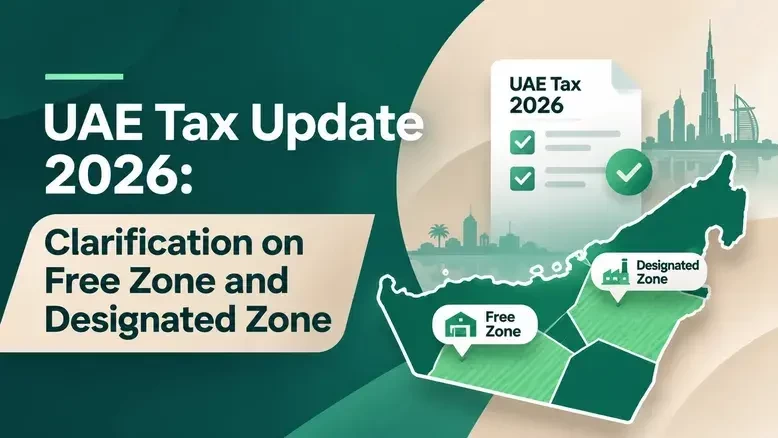
UAE Tax Update 2026: Clarification on Free Zone and Designated Zone
Running a business in the UAE free zones offers various tax benefits, but confusing free zones with designated zones is one of the biggest mistakes many companies make. Recently, the UAE Federal Tax Authority released some important clarifications on both fee zones and designated zones working on corporate tax and value-added tax. It is also important to note why having a free zone trade license alone does not guarantee tax-free operations.
In case the company deals with goods or provides services and arranges distribution within a free zone in the UAE, it should understand the distinction between both zones to keep the 0% corporate tax and avoid VAT obligations.
The Difference between Free Zone and Designated Zone
Despite the similarity of the names and even their interchangeable use in common business discourse, in UAE taxation, these two terms refer to something quite distinct:
What Is a Free Zone?
A Free Zone is a designated and defined geographical area within the UAE, specified through a decision issued by the UAE Cabinet at the suggestion of the Minister. For taxation purposes, Free Zones are relevant under UAE Corporate Tax, Excise Tax and VAT legislation. A business incorporated or registered in a recognised Corporate Tax-Free Zone may qualify as a Qualifying Free Zone Person (QFZP) and benefit from the 0% Corporate Tax rate on its Qualifying Income, provided it satisfies all the conditions prescribed under the Corporate Tax Law and relevant decisions.
What Is a Designated Zone?
A Designated Zone is an area recognised under specific UAE tax legislation. However, the definition and requirements differ depending on whether the zone is considered for Corporate Tax, VAT or Excise Tax purposes.
For VAT purposes, a Designated Zone must be included in the list specified under Cabinet Decision No. 59 of 2017 and its amendments and satisfy the conditions prescribed under Article 51(1) of the VAT Executive Regulation.
For Corporate Tax purposes, a Corporate Tax Designated Zone must qualify as both a VAT Designated Zone and a Corporate Tax-Free Zone.
Clarifications on the 2026 FTA Businesses Should Be Aware of
FTA 2026 guidance underlines the basic contents that tax credits depend on the existence of a genuine transaction and physical presence rather than documentation only. The four clarifications below should be taken into account by UAE businesses:
1. Services Are Not Entitled to "Designated Zone" VAT Credit
Many businesses mistakenly believe that being situated in a designated zone makes all invoices exempt from VAT. The FTA has clarified unequivocally that the VAT relief provisions regarding Designated Zones apply solely to tangible goods, never to services. Consulting, IT, marketing, management, and training services supplied from a designated zone to a client situated on the UAE mainland will always remain taxable at 5%.
2. Qualifying Distribution Requirement Involves Physical Entry into the Designated Zone
As per the Corporate Tax laws of the UAE, distribution of goods/materials in or out of a designated zone to resellers or corporate customers (not end-users) constitutes a qualifying activity that can be taxed at 0% Corporate Tax. But according to the guidance issued for 2026, it is important that:
- The goods should be physically entered in the designated zone, stored there, or passed through the designated zone (or brought into the UAE by way of customs).
- Shipment of goods directly from one foreign supplier to a foreign buyer, without the passage through the UAE and a designated zone, would not automatically be considered a qualifying activity for the purpose of designated zone distribution unless other qualifying activities exist.
3. Economic Substance Mandatory for 0% Corporate Tax
Having a virtual flexi-desk or dummy shell office in the Free Zone will not be sufficient to claim 0% corporate tax. To be able to maintain its Qualifying Free Zone Person status the company would be required to show economic substance in the Free Zone by:
- Physical implementation of Core Income Generating Activities (CIGA) in the Free Zone.
- Hire sufficient well-qualified full-time employees in the Free Zone.
- Physical office/warehouse space and the costs associated with operating the business locally.
What is corporate tax designated zone in UAE?
As per the UAE tax law the designated zone is the are considered as the specified type of freezones which meet certain criterion which includes the following:
- It must be a VAT designated zone
- It must be qualified as a freezone under the UAE CT law.
When would the designated zone be treated as outside the UAE?
Designated zone would be treated as outside the UAE for the purposes of VAT if the following conditions are met as per the VAT executive regulations which would include:
- There must be secured custom controls on the movement of people and goods and it must be fenced
- Must have the procedures for the maintenance, storage and processing of goods
- The operation must comply with the UAE FTA procedures.
What is a designated zone for the purposes of excise tax?
As per the clarification if the following conditions are met then it would be considered as a designated zone for the Excise Tax purposes:
- It must be a fenced freezone, must have customs supervision, warehouse keeper and security controls
- It must be a geographical area approved by UAE FTA.
How CDA Can Assist Your Business ?
CDA, a leading accounting, auditing, and tax consultancy firm in Dubai, UAE, providing tax services by registered tax professionals who can help safeguard your business. With our team’s assistance in reviewing Free Zone QFZP compliance, performing Designated Zone VAT compliance check-ups, and preparing the necessary audited financials and transfer pricing documentation, you can rest assured that you will receive a customized service package.
Contact CDA today for a consultation on UAE Corporate Tax and VAT compliance.

Mitesh Maithia
Tax Manager
Mitesh is a Tax Professional with expertise in direct, indirect, and international taxation, including transfer pricing, since 2018. Passionate about making complex tax matters simple, he shares insights to help businesses stay compliant and forward-looking.