
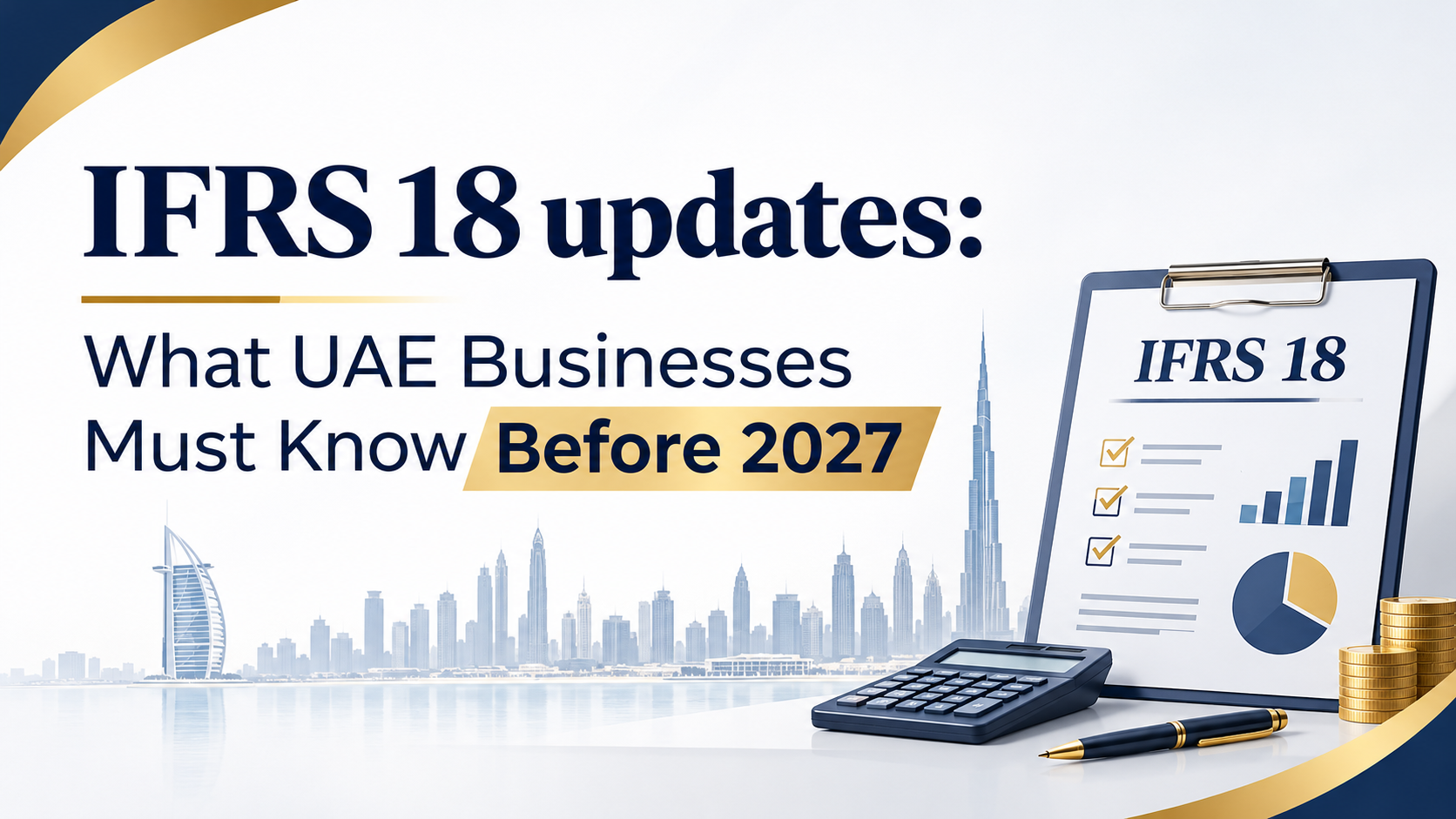
IFRS 18 updates: What UAE Businesses Must Know Before 2027
The system of financial reporting in the UAE is working on its biggest structural overhaul in the last two decades. The latest IFRS standard issued by the International Accounting Standards Board (IASB), IFRS 18 (Presentation and Disclosure in Financial Statements) will supersede the earlier standard IAS 1 for reporting periods beginning on or after January 1, 2027.
UAE Commercial Companies Law, Free Zone regulations (DIFC, ADGM, DMCC, JAFZA), and UAE Corporate Tax require financial statements to be prepared in accordance with IFRS. This will impact all organizations who are preparing IFRS financial statements. It is very important to note that as IFRS 18 is to be applied retrospectively, as your 2026 financial year is the comparative period.
Why is IFRS 18 important right now in 2026?
In accordance with IAS 1, there was significant flexibility in the format and structure of the Statement of Profit or Loss and the definition of subtotals such as “Operating Profit,” which made comparisons among companies, problematic for investors, lenders, and regulators.
With IFRS 18, the following is now strictly standardized in the three major pillars:
- The standardized Statement of Profit or Loss includes five categories and two mandatory subtotals.
- Disclosures at an audit level of Management-Defined Performance Measures (MPMs).
- Standardized criteria on the grouping and disaggregation of items.
Major IFRS 18 Changes That UAE Businesses Should Know About
1. Five Mandatory Categories in the Statement of Profit or Loss
According to IFRS 18, all income and expenses in the Statement of Profit or Loss should be segregated into five categories:
- Operating Category: This serves as the default category for all income and expenses from a company’s ordinary business activities that cannot fit in any of the other four categories.
- Investing Category: Returns from assets that generate returns independently of the entity’s primary operations, such as income and expenses from associates, joint ventures, cash and cash equivalents, and investment properties.
- Financing Category: Deals with revenues and expenses related to transactions of obtaining finance (such as borrowing from banks and issuing bonds). Also, interest expense on other liabilities such as leases and pensions.
- Income Taxes Category: Relates to corporate tax revenues/expenses recognized in accordance with IAS 12.
- Discontinued Operations Category: Shows results of operations of discontinued activities as per IFRS 5.
For UAE Banks, Insurance, and Real Estate Investment Companies: Organizations where specified activity relates to investing in assets (such as UAE real estate investment companies) or financing to customers (banks and finance companies) have unique rules for classification of certain investing or financing income or expense within the operating category.
2. Two New Required Subtotals on the P&L
All entities required to prepare financial statements under IFRS 18 need to provide two subtotals for their P&L:
- Operating Profit or Loss: Represents total revenues and expenses classified within the operating category.
- Profit or Loss Before Financing and Income Taxes: Represents operating profit or loss together with all revenues and expenses in the investing category.
3. Disclosure Requirements for Management-Defined Performance Measures (MPMs)
Many companies in the UAE state custom measures such as Adjusted EBITDA, Core Operating Profit, or Normalized Net Income in press releases, investor presentations, or annual reports.
- In accordance with IFRS 18, any subtotal of income and expenses that is communicated publicly outside the financial statements in order to represent the management’s view on financial performance constitutes an MPM.
- A company should include disclosure regarding all MPMs within a single note in the audited financial statements, including reasons why such MPM is useful, its calculation method, and a full reconciliation to the nearest IFRS sub-total (considering tax effects and non-controlling interests).
4. Strict Aggregation, Disaggregation & Cash Flow Updates
- No Vague Other Labels: IFRS 18 prohibits the use of vague captions such as “Other Expenses” or “Miscellaneous Income” for material balances unless accompanied by a meaningful description and explanatory notes.
- Operating Expense Analysis: Where an entity discloses operating expenses by function (such as Cost of Sales, Selling, and Administrative), the details of the specific nature of the expense (such as depreciation, amortization, employee benefits, impairment losses, and inventory write-downs) shall be disclosed in one note.
- Statement of Cash Flows (Amendments to IAS 7): The indirect method mandatorily requires operating profit or loss as the single starting point for cash flow reconciliation and standardizes the classification options for interest and dividends paid/received.
The change from IAS 1 to IFRS 18 is a major step forward in financial reporting transparency in the UAE. The effective date is required to be January 1, 2027, but thanks to retrospective comparative reporting, the real work begins today as you close out your 2026 financials. Updates to the chart-of-accounts, MPM reconciliations, or covenant reviews delayed until 2027 could lead to costly audit delays and misstatements in reporting.
How Can CDA Can Support Your Businesss ?
IFRS 18 implementation success needs detailed technical accounting knowledge and practical support for ERP implementation. CDA is a trusted accounting, auditing and financial advisory firm in the UAE. We have specialist IFRS consultants available to assist your finance team. We provide end-to-end compliance solutions covering the full spectrum of IFRS 18 impact assessments, Chart of Accounts redesign, preparation of restated 2026 comparative financial statements and MPM disclosures for audit.
Feel confident as you prepare your 2027 financial statements. Get in touch with CDA today to schedule your IFRS 18 readiness consultation with our accounting and audit experts in the UAE.

Jijo Saji
Senior Auditor
Senior Auditor with over 10 years of experience in auditing, taxation, and financial reporting. Proven expertise in statutory audits, VAT compliance, and advisory services across diverse industries.