
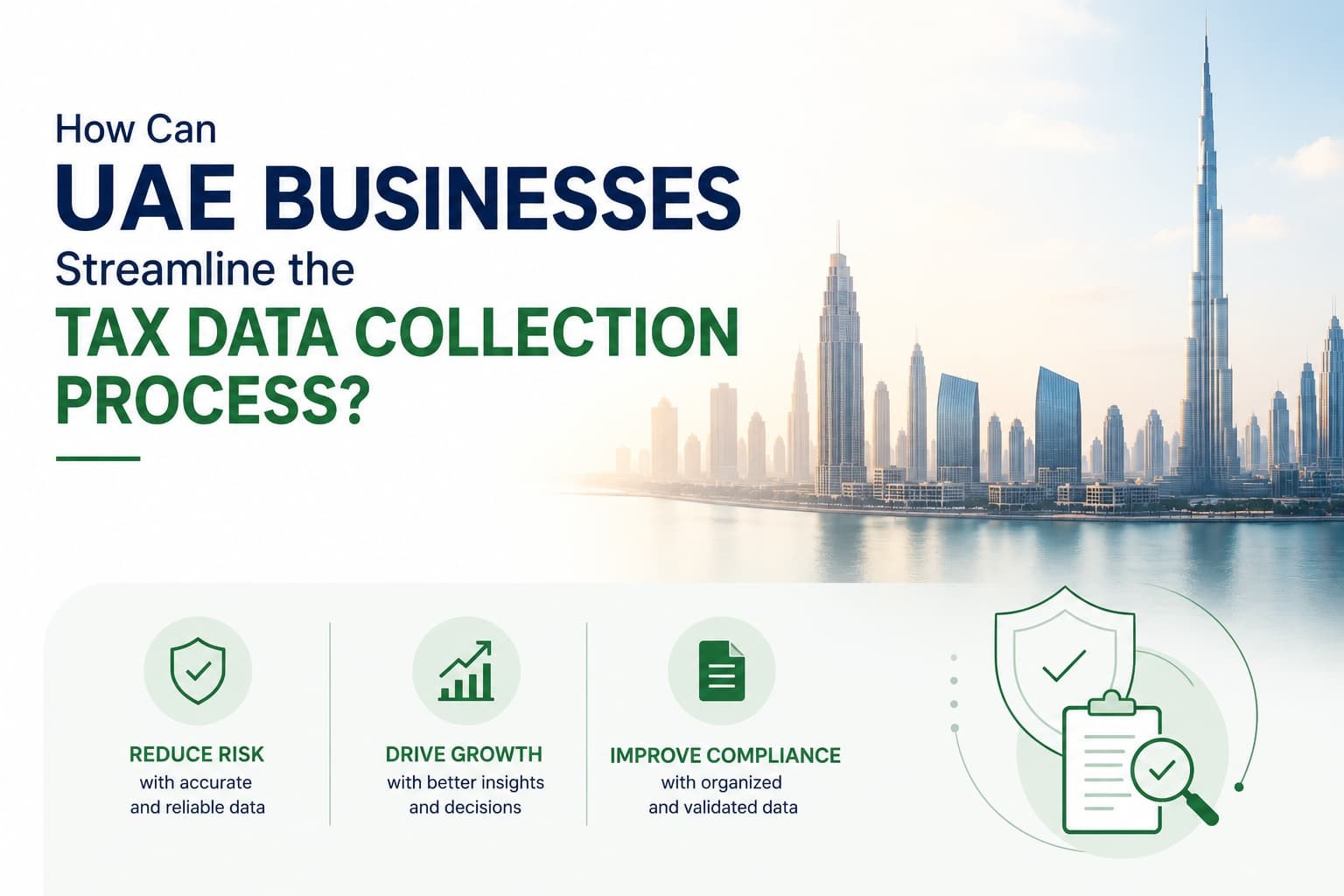
How Can UAE Businesses Streamline the Tax Data Collection Process?
If you run a business in the UAE, you probably understand the environment during the tax filing period. The craze to pull together any and all financial records, invoices, documents, etc., just before the deadline dawns. In 2026, going this way is not just stressful; it is genuinely risky.
The good news is that streamlining this process is entirely within reach for the UAE businesses. And it's actually not even about working harder in the two weeks before a deadline. It's all about having a system that keeps you tax-ready all year round.
Start With People and Process, not only Technology
Technology is what most businesses reach for first, but it can't save a process that's broken at its foundation. Before anything else, two things need to be in place.
One: Someone needs to take ownership of the data collection process - this could be someone in your organization or an outside entity. Internally, your financial controller or chief accountant would be responsible for the calendar, the templates, and the overall compliance rhythm. This person can be the single point of accountability to ensure timely collection, compliance, and calculation of the tax and tax-related documents.
Two: Alongside that, you need a shared tax calendar that works backward from each filing deadline. Not "VAT return due on the 28th," but internal deadlines for when sales invoices must be issued, when expense claims must be submitted, and when bank reconciliations must be completed. Set these in advance before the FTA deadline to avoid chaos and lateness.
Standardise What You Collect
One of the quieter sources of compliance risk is inconsistency: This can show up like different departments submitting information in different formats, at different times, with different levels of completeness. Standardising this might take a bit of effort, but it pays back tenfold.
For VAT and UAE corporate tax filings, your data collection process should cover:
- A complete sales ledger broken down by VAT treatment (standard-rated, zero-rated, exempt, and out of scope).
- A full purchase ledger with recoverable input VAT clearly identified
- All tax invoices issued and received are verified for FTA compliance (TRN, VAT amount, sequential numbering)
- Bank statements, fully reconciled for the period
- For Corporate Tax, fixed asset schedules, payroll records, financing details, and a breakdown of any related-party transactions
- Credit notes issued or received, and any bad debt relief being claimed
Let Technology Do the Heavy Lifting
Never underestimate what tech can do for your system. A good cloud-based accounting system, preferably one that is designed for the UAE’s tax environment, can automate a significant portion of what finance teams do manually all year around.
Automated bank feeds pull transactions directly from your bank accounts every day, eliminating manual entry and ensuring nothing is missed. OCR-enabled expense apps let employees photograph receipts on the spot, with the data extracted and coded automatically.
Integrated invoicing helps capture every sale at the point of issuance, and centralised document storage attached to each transaction creates the kind of audit records that make FTA queries smooth and manageable rather than panic-inducing.
Reconcile Monthly, Not Quarterly
This is where a lot of businesses undermine decent systems. They collect data reasonably well throughout the period, but they only reconcile accounts right before the filing deadline. At that point, any discrepancy becomes an emergency.
This is a bigger signal for you to get your collection of data in a row and engage a fully adept internal team for streamlining the entire tax data collection process, or consult a reputed tax and audit firm to do this for you.
Conclusion
Tax data collection isn't really a tax function. It's a business process that touches every department: sales, procurement, HR, and operations. When it works well, your finance team spends filing periods reviewing and confirming, not firefighting.
Your management has financial information they can actually act on. And if the FTA comes knocking, you respond in days, not weeks; hence, building that system takes some deliberate effort.
How Can CDA Help in Streamlining the Tax Data?
CDA has been providing professionalized tax services to the businesses in UAE for more than a decade. The experts of CDA can assist the business in identifying the vital data for the tax purposes along with collecting and maintaining it as per the regulations. The businesses can avoid any tax penalties or fines and ensure that the returns are calculated beforehand and hence ensure accuracy with no mistakes.
CDA’s tax professionals can help you streamline your data collection process without any major hassle and prepare for FTA scrutiny. Get in touch with us for a consultation today!

Mitesh Maithia
Tax Manager
Mitesh is a Tax Professional with expertise in direct, indirect, and international taxation, including transfer pricing, since 2018. Passionate about making complex tax matters simple, he shares insights to help businesses stay compliant and forward-looking.